A correct demonstration and a failed attempt teach different lessons. An agent trained only to copy successful traces may learn the expected route without learning how to recover when a tool returns an unfamiliar result. Choosing a training method therefore begins with the kind of feedback available, not just the size of the model.
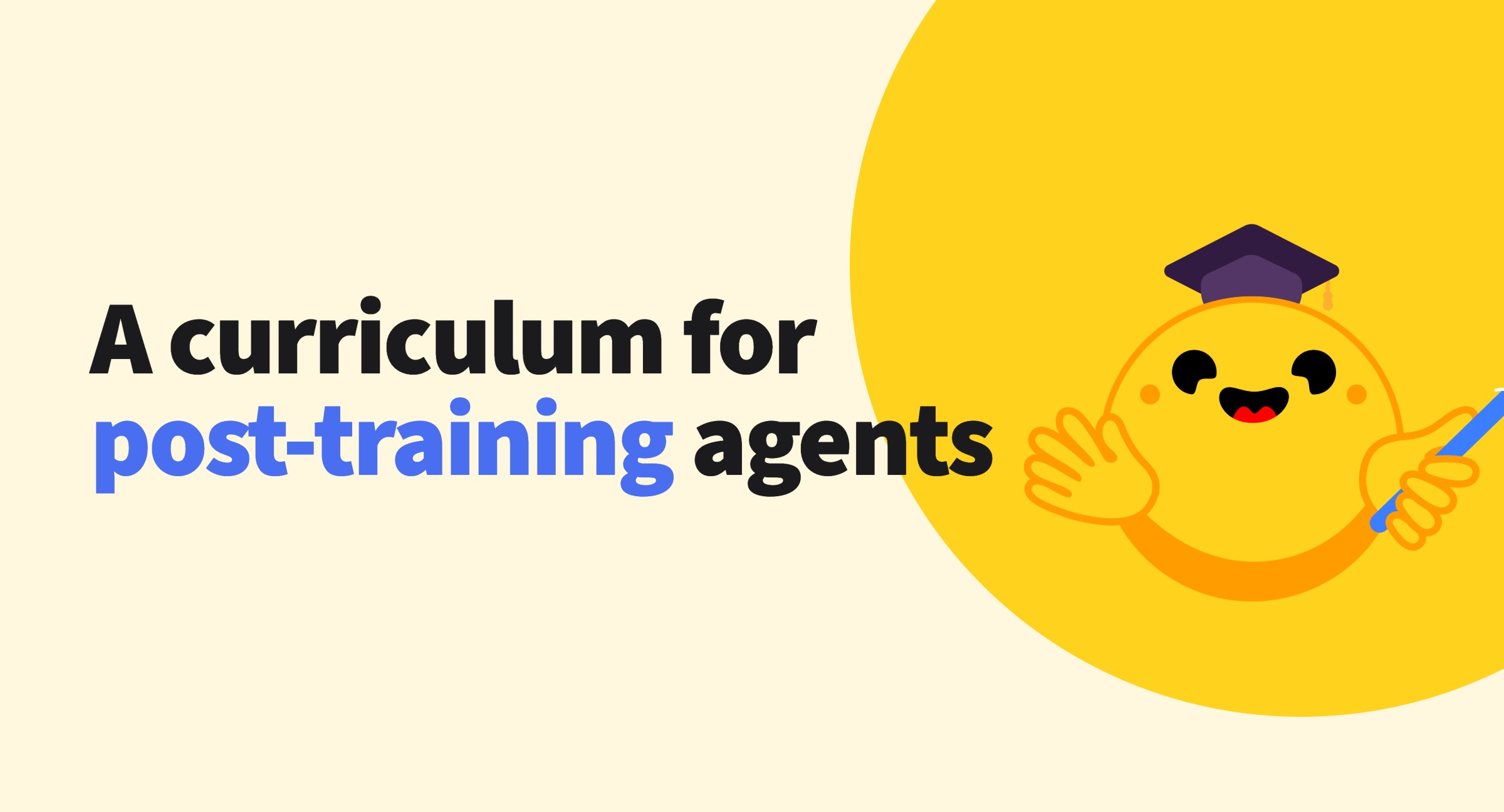
Hugging Face’s October 20 curriculum organizes agent post-training into supervised fine-tuning, distillation, reinforcement learning, interactive environments and training through a full agent harness. It links documentation, example projects and instructional sessions. This is an educational release, not a new benchmark claim or evidence that one sequence is optimal for every agent. Primary source.
Match the signal to the failure
The guide distinguishes token-level teacher feedback from rewards for completed answers or episodes. It also describes the move from single responses to environments that preserve state across tool calls. At the final stage, training uses the agent’s execution harness so that the learning setup more closely resembles operation.
For a developer, these distinctions help diagnose what a dataset cannot teach. A collection of successful final answers may not record the tool result that should have caused a change of plan. A reward based only on completion may overlook unnecessary actions or unauthorized side effects. The missing information has to be addressed before adding more training compute.
Recovery needs a test of its own
A useful first experiment is to introduce a controlled interruption into a familiar task: an unavailable tool, a changed file or an unexpected response. Observe whether the agent notices the change, recovers and preserves the user’s objective. Compare that behavior before and after training instead of relying only on an aggregate completion score.
Training through a realistic harness can reduce one source of mismatch, but it does not eliminate differences between a sandbox and production. Permissions, latency and external state can still change. Those conditions should be represented explicitly in evaluation wherever they affect the task.
The curriculum could lower the effort required to assemble a coherent learning workflow from existing tools. Its longer-term value depends on whether teams use it to build better feedback and more informative tests. The important next evidence is a reproducible improvement on the failure that motivated training, rather than a more elaborate pipeline by itself.
References
Questions, news tips or corrections? Contact [email protected].