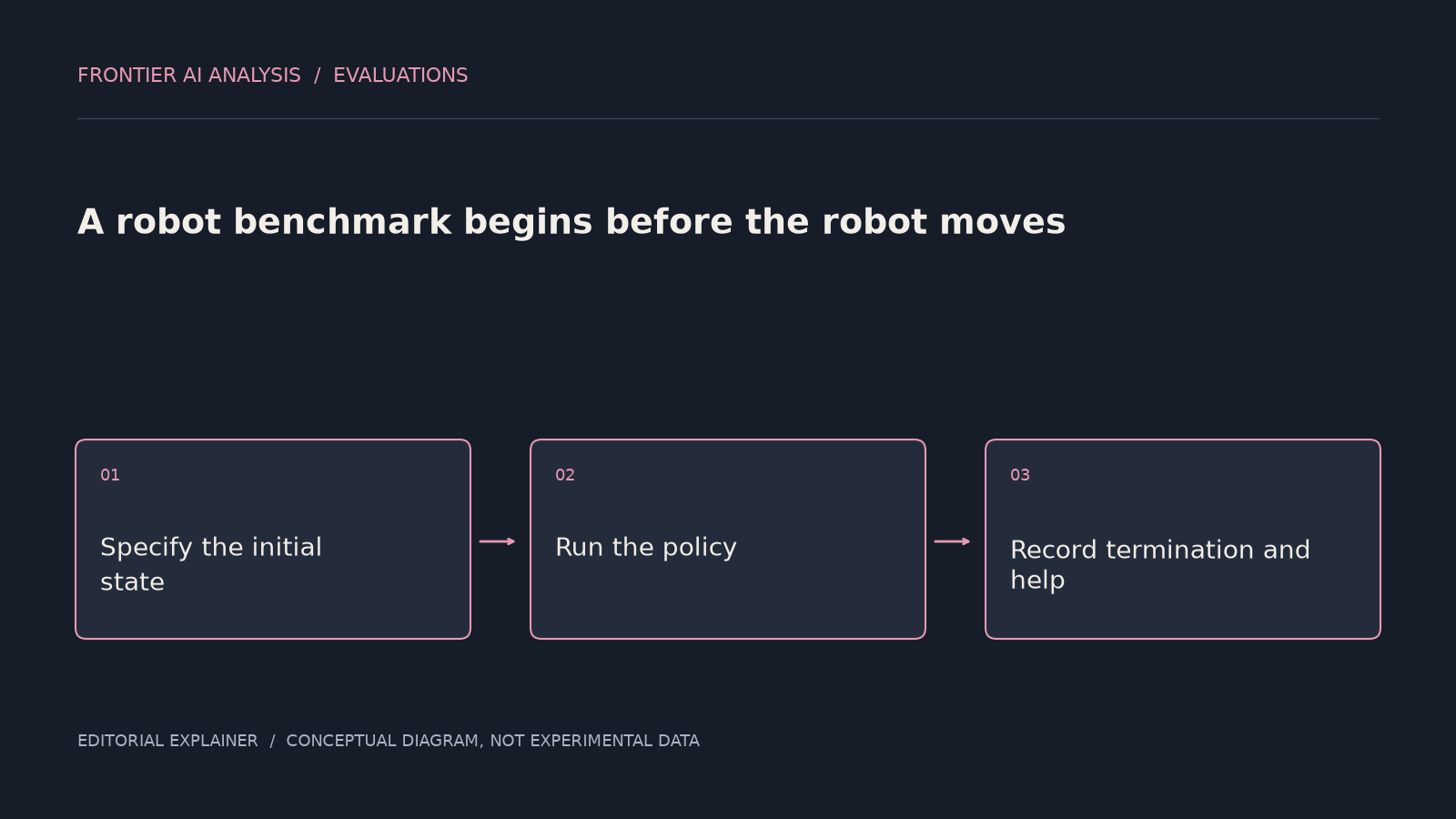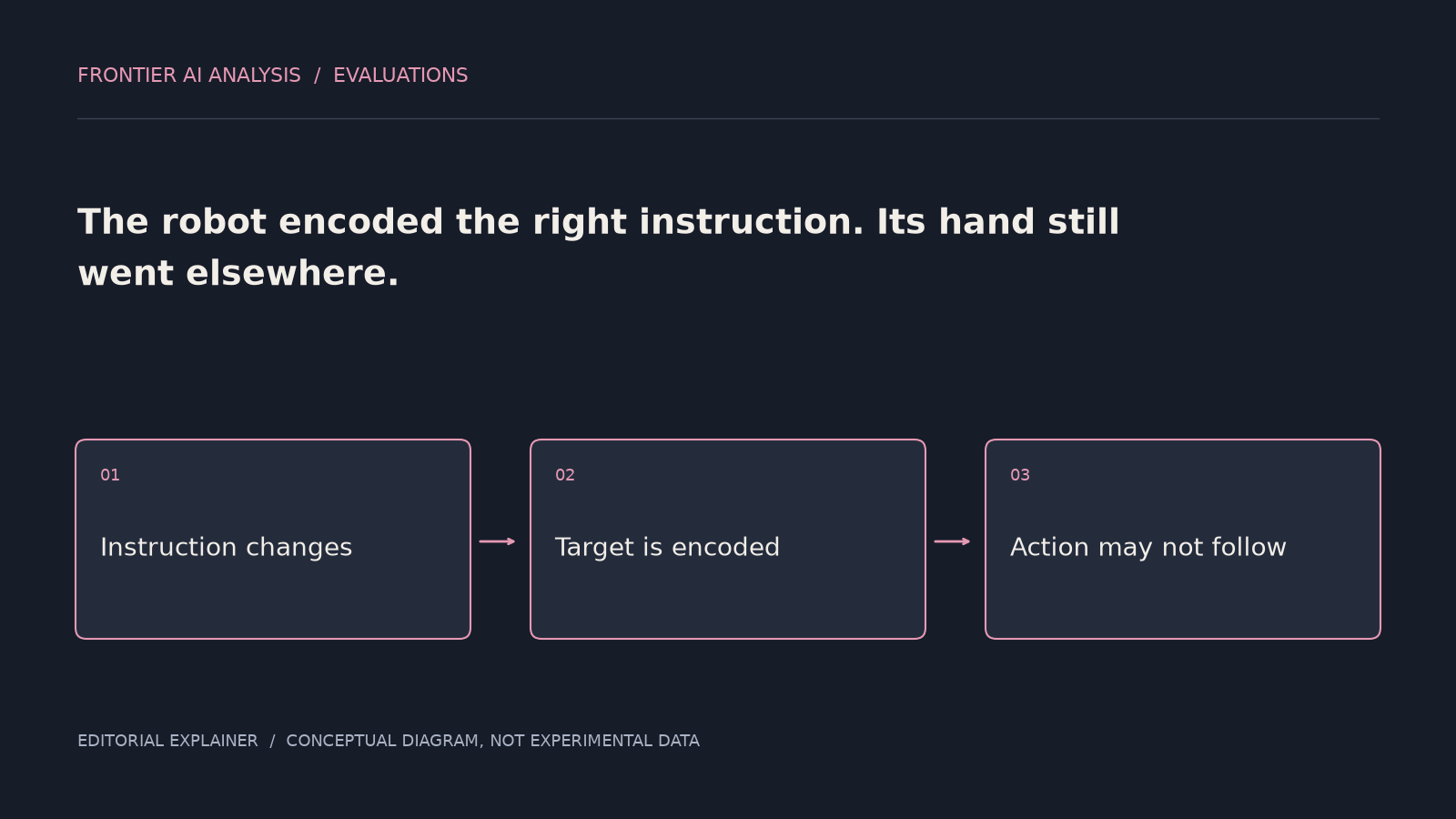
Change the requested object. Leave the scene alone. If a robot is following language, its choice should change too.
That straightforward intervention produces an uncomfortable result in a paper posted October 5 by Shaohan Jiang and colleagues. Across the policies they evaluate, robots predominantly approach the original, scene-associated target when asked to pick a different visible object. The researchers test vision-language-action policies and world-action models in simulation and physical experiments.
The surprise comes from looking inside. Probes can recover the requested target from intermediate representations. The instruction has left a measurable trace. It nevertheless rarely determines which object is selected. Attention analysis suggests weak contributions from instruction tokens to action generation, though attention alone is not a complete causal explanation.
Knowing where to look inside a model is not enough
For an engineer, this complicates a reassuring diagnostic. Suppose a probe accurately reads “blue cup” from a policy’s internal state. It is tempting to conclude that language understanding is working and look elsewhere for the problem. But information can be available without being used by the downstream computation that chooses a grasp.
A simple analogy is a dashboard with an accurate warning that nobody consults. Improving the warning’s accuracy does little if it has no authority over the next decision. In a learned policy, the corresponding issue is whether changing the instruction changes the action while other inputs remain fixed.
This distinction also changes what a successful demonstration proves. In a scene that strongly suggests one familiar task, visual context and language may agree. Completing the task then cannot reveal which input won. The apparent instruction-following skill may remain untested until someone requests a plausible alternative.
Put competing intentions in the same scene
An evaluation built around this finding would give the same physical arrangement several valid instructions. It would measure target selection separately from grasp execution. Otherwise a policy could be excellent at picking up an object while consistently choosing the wrong one.
The clean comparison matters. Swapping an instruction and rearranging the room at the same time would make it harder to identify the source of a behavioural change. Likewise, a physically impossible request would confound language obedience with feasibility. The strongest tests create a real choice between actions the robot can perform.
These experiments do not establish that every robot policy ignores language. They expose a failure mode in the evaluated systems and a way to look for it. They also suggest a useful training question: does the dataset contain enough identical or similar scenes paired with different legitimate intentions to make language necessary?
That question reaches beyond a benchmark score. A robot meant to serve a person must allow that person’s request to override what the room usually predicts. The requested object being present somewhere in the network is only the beginning of that obligation.
References
Questions, news tips or corrections? Contact [email protected].