Suppose two robot policies each complete 90 out of 100 trials. That sounds like equal capability until you discover that they fail on different trials.
The arithmetic leaves room for a serious regression. The faster policy could fix five cases and break five that previously worked. Its aggregate score would not move. An operator whose production process depends on the newly broken cases would notice immediately.
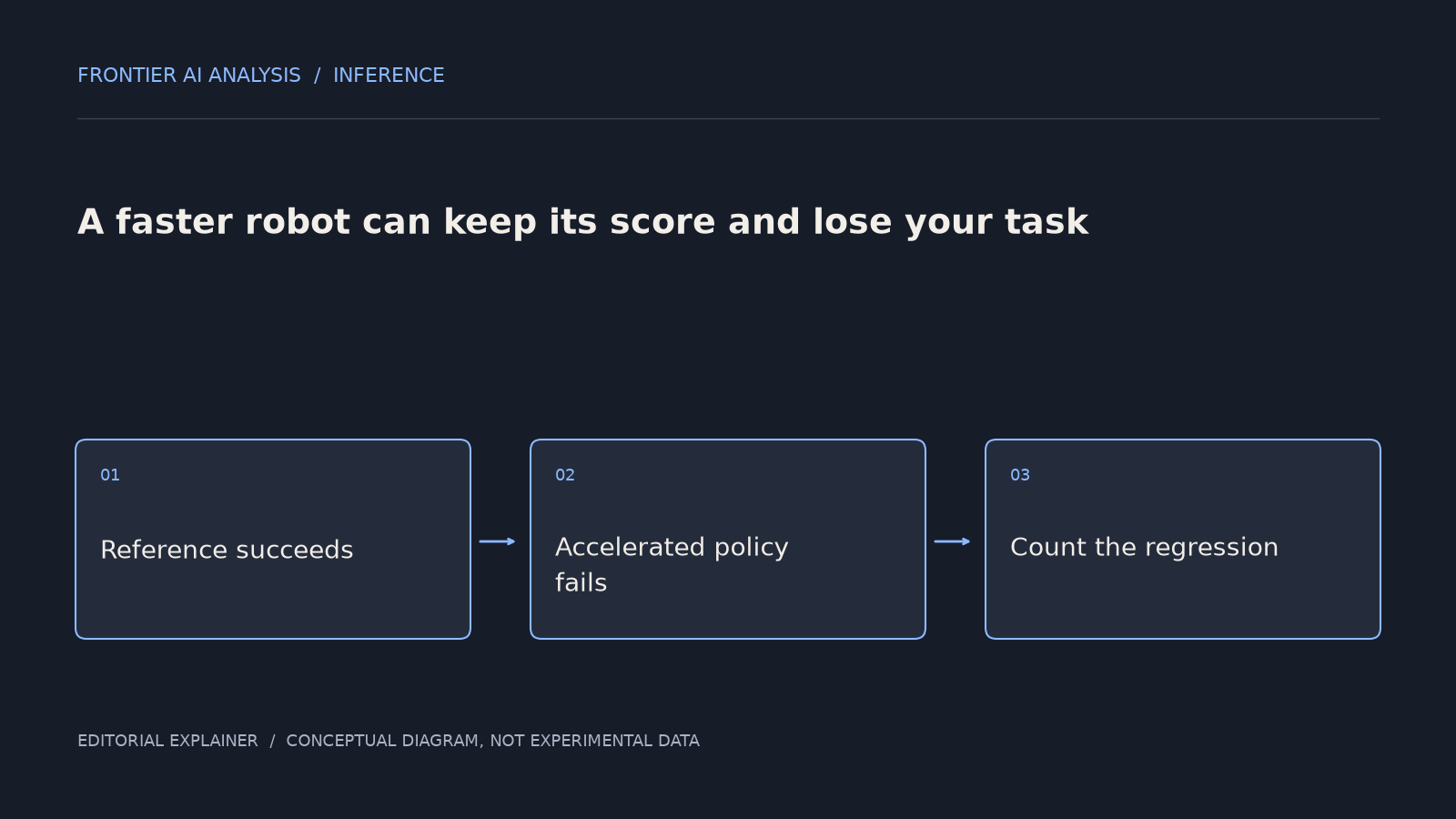
CARE, posted October 6, tackles this with paired rollouts from identical initial conditions. It counts cases where the reference succeeds and the accelerated policy fails, then selects the fastest candidate meeting a calibrated risk budget. On its OpenVLA-OFT LIBERO experiments, the authors report 9.0–10.8 times speedups and a 95-percent-confidence guarantee preserving at least 85.8 percent of reference-solved episodes.
The denominator changes the question
That last figure is conditional on what the reference could solve. It is not an 85.8 percent overall success rate. It is also not a general safety certification. The statistical guarantee depends on the evaluation procedure and its assumptions; it does not cover arbitrary changes in the deployed environment.
The conceptual improvement is nevertheless valuable. Rather than asking whether acceleration has kept the average high, it asks how much existing capability acceleration has destroyed. Those questions are related but not equivalent.
For a developer, a paired outcome table is often more informative than two bars. It separates preserved successes, new successes, persistent failures and new failures. The last category deserves its own investigation, even when gains elsewhere make the release look better overall.
A regression budget is a product decision
The budget cannot be chosen by an accelerator benchmark alone. Losing a rare capability may be acceptable in an exploratory demo and unacceptable in a workcell built around that capability. A team needs to define which tasks are substitutable and which are obligations.
This suggests testing within meaningful groups as well as across the whole suite. A single aggregate budget can conceal concentration: most new failures might involve the same object material or recovery manoeuvre. The statistical machinery does not remove the need to choose a representative calibration set.
There is another practical limit. Physical trials cannot always reproduce initial conditions exactly. Small differences in placement, friction and hardware state can blur whether a failure came from acceleration. Simulation makes pairing easier; real tests need careful randomisation and enough repetitions to estimate that variability.
CARE turns speed optimisation into a more accountable comparison. The operator’s question becomes specific: what could the old policy do that the new one no longer can? A faster cycle is valuable. It is more valuable when the team can name what was traded away to obtain it.
References
Questions, news tips or corrections? Contact [email protected].