A finger can look as though it is holding a cup while passing straight through it. For a viewer, the error may last a frame. For a robot trained on the sequence, it can corrupt the relationship between action and consequence.
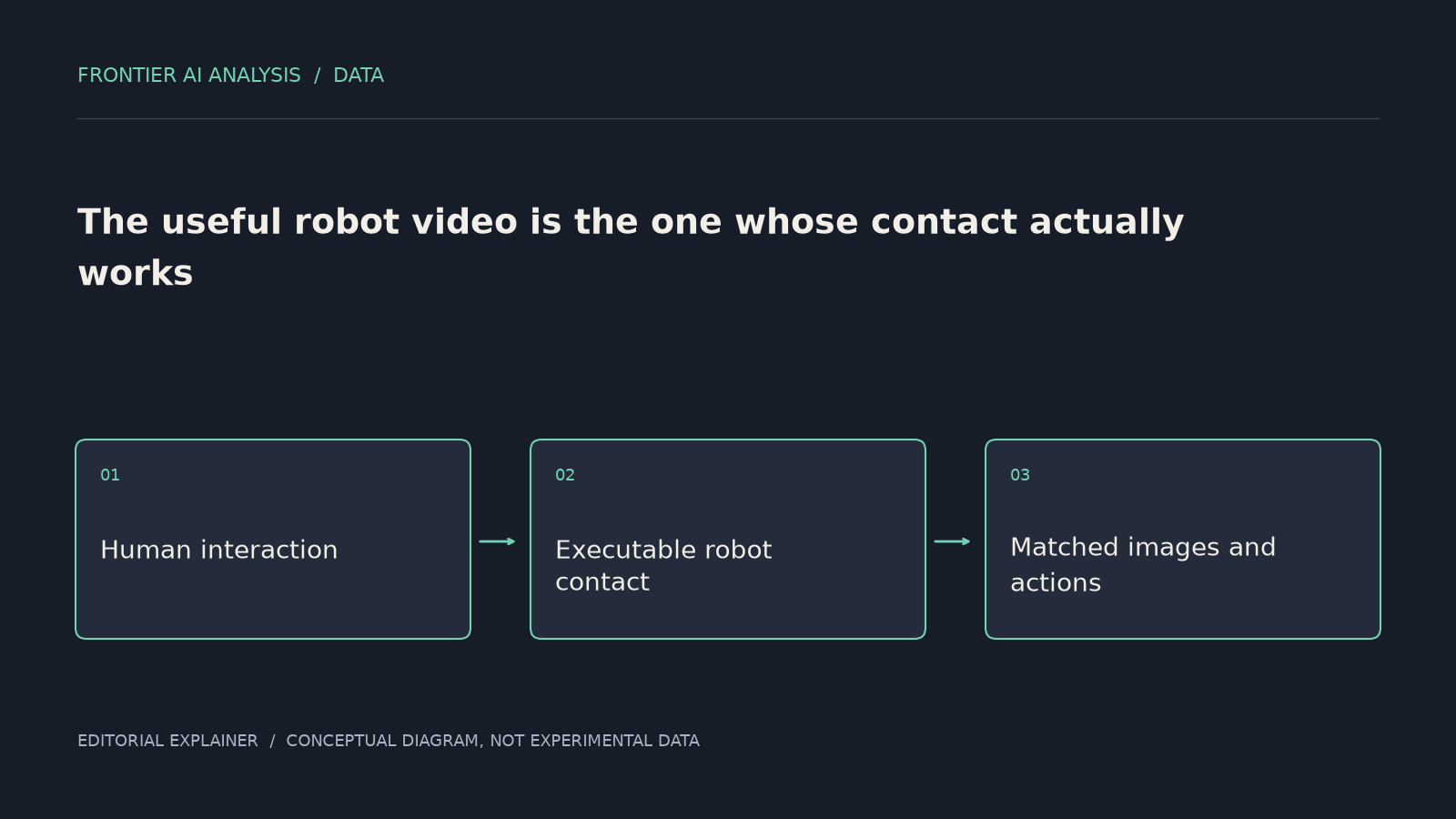
EgoMatrix, posted October 13, converts egocentric human video into robot trajectories and paired visual observations. It emphasises relative hand–object geometry and contact, then uses retargeting and reinforcement learning in simulation. Robot hands and objects are rendered together from the resulting trajectories. The authors report 54.84 percent end-to-end success in simulation, against 14.52 percent for their strongest baseline.
The central wager is that a useful demonstration must preserve the interaction, even if exact metric reconstruction of the whole scene is not the priority. That simulation result is not a factory deployment rate.
A picture can be right for the wrong reason
Visual similarity and physical consistency answer different questions. A rendered image may closely resemble a human recording while depicting a grasp the robot cannot execute. Another image may have a different background yet correctly pair the robot’s action with the object’s motion.
For policy learning, that pairing is crucial. If the state record says the gripper closed but the rendered object moves independently, the learner receives contradictory supervision. Increasing the number of such examples could make the contradiction more influential rather than average it away.
Human-to-robot conversion adds a second difficulty. A person’s fingers and a robot’s hand do not share identical joints, reach or force limits. Preserving every human joint angle would be a strange definition of fidelity if it made the robot demonstration impossible. The transferable element may instead be a sequence of contact relationships that accomplishes the task.
Diversity after consistency
Once an executable interaction is established, visual variation can serve a more precise purpose: changing nuisance appearance while holding the relevant mechanics fixed. That creates an opportunity to test whether a policy follows the contact process or memorises the setting.
The boundary still needs checking. A new background may be visually plausible but imply a surface height or obstruction inconsistent with the simulated motion. “Task-compatible” augmentation is therefore a constraint on data generation, not a cosmetic preference.
A strong audit would examine synchronized frames, states and controls around contact transitions: the moment of grasp, the onset of slip, the release. Those are the points where a small mismatch can change the lesson. Image-quality scores alone may miss them.
EgoMatrix offers a concrete reason to resist equating photorealism with training value. The best synthetic demonstration may be the one in which every modality tells the same physically possible story. Beauty helps a viewer believe a video. Agreement between action and consequence is what gives a robot something reliable to learn.
References
Questions, news tips or corrections? Contact [email protected].