Before training a model to translate between two sensors, there is another option: make the sensors speak more nearly the same language.
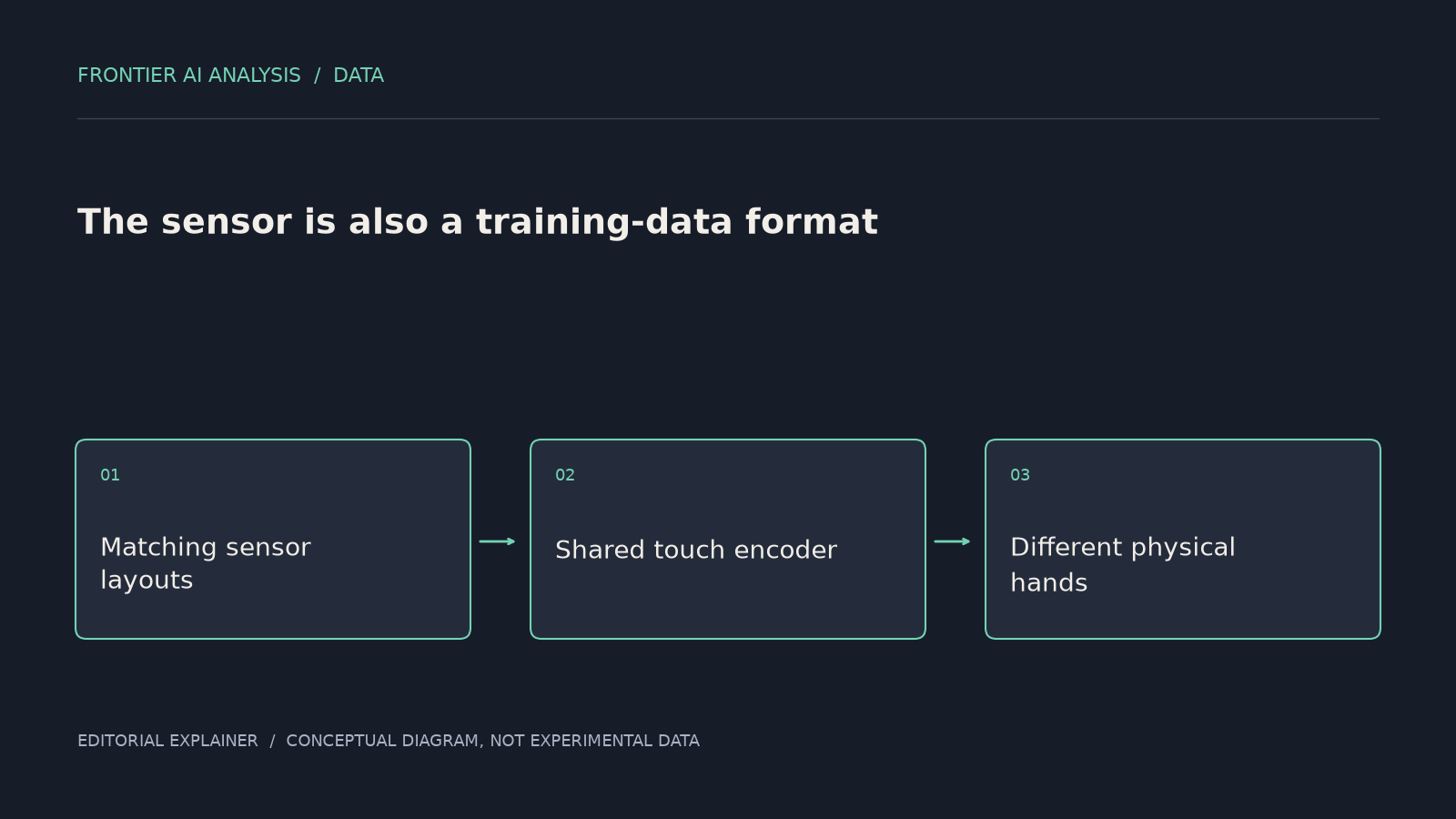
SoTa, described in an October 1 paper, uses matching 202-taxel tactile layouts on human and robot hands. The authors report materials costing less than $10 and use a common encoder rather than a learned cross-sensor mapping. With a fixed robot-demonstration budget, adding human demonstrations raises mean success from 22.8 to 45.9 percent across eight tested conditions. The paper describes plans to open-source the system.
The result makes a quiet point about AI development: a hardware decision can simplify the statistical problem before any optimiser runs.
Compatibility can be manufactured
When sensors have incompatible layouts, a learning system must discover which measurements correspond. Some of its training budget goes toward that translation. Matching layouts can remove one source of ambiguity, allowing more of the available data to bear on the interaction itself.
That suggests a different way to evaluate a sensor purchase. Resolution and sensitivity matter, but so does compatibility with the data a team expects to collect. A sophisticated device with an unusual output format could be harder to integrate into a shared training pipeline than a simpler, consistent one.
This is not an argument that cheap hardware is always preferable. A sensor that misses the physical signal needed for a task cannot be rescued merely by matching another sensor. The relevant trade-off is between adequate measurement and the cost of translating that measurement across the collection and deployment systems.
Matching skin does not make matching hands
There is a boundary to the idea. Human and robot fingers can share a tactile layout without sharing mechanics. Joint limits, compliance and available force still affect which actions are possible. A common touch representation does not turn a human movement into a valid robot command automatically.
For that reason, the fixed robot-data comparison is useful. It asks whether human recordings make an existing robot supervision budget more productive. It does not ask readers to pretend that the two kinds of demonstrations are interchangeable.
The next engineering question would be how the representation survives ordinary hardware variation. Replacement skins, calibration drift and wear may matter more after weeks of use than they do in a short experiment. A format that works only for perfectly matched fresh sensors would be less valuable as a collection standard.
SoTa invites a broader reconsideration of data infrastructure. The standard need not begin with a file specification or a neural adapter. It can begin with where sensing elements are placed on a hand. That choice determines which correspondences the model receives for free and which it must learn from scarce examples.
References
Questions, news tips or corrections? Contact [email protected].