There is an awkward timing problem in asking a driving model to explain itself before it acts: the road does not pause while the answer is written.
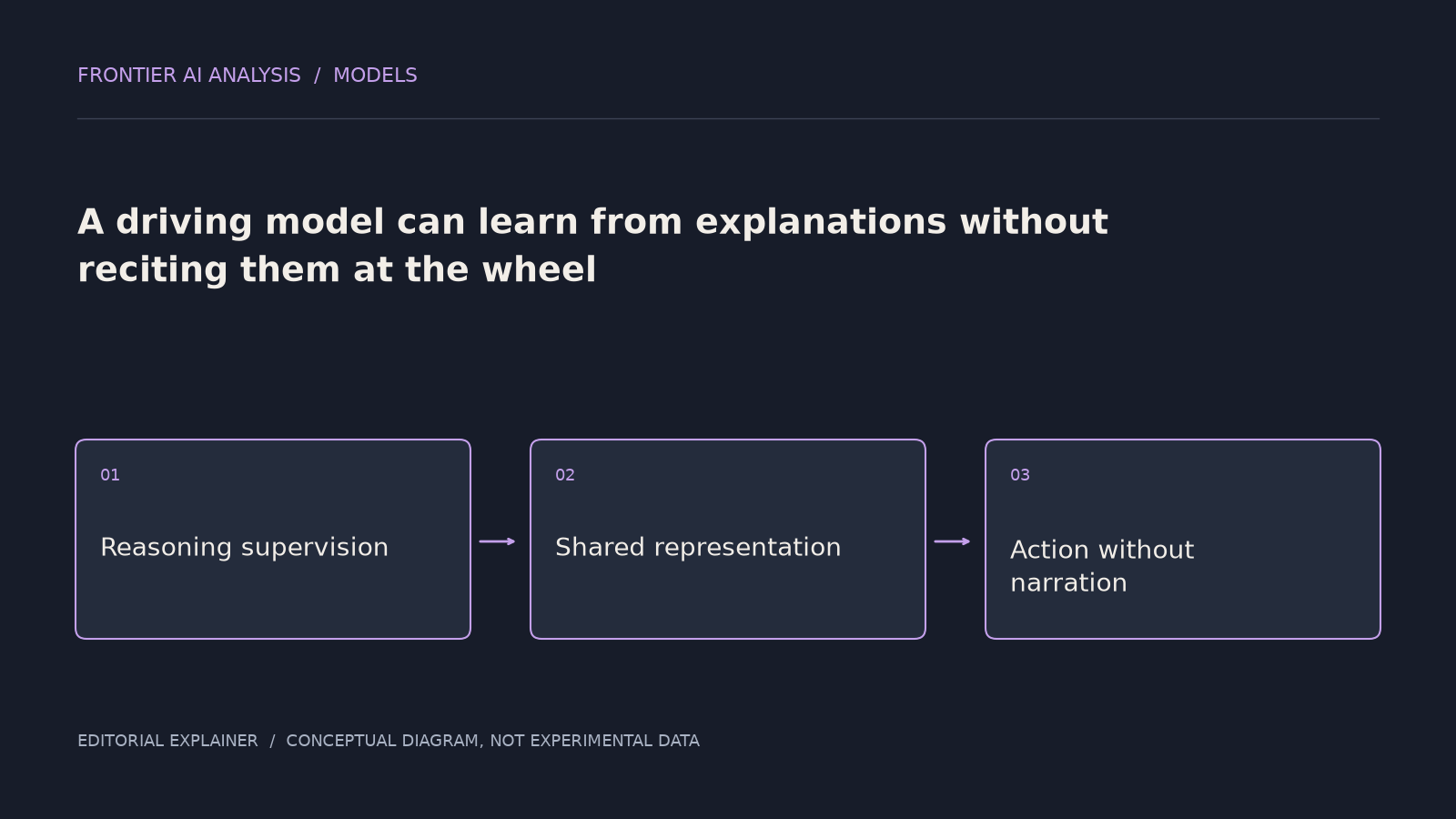
AUGUstus, posted October 12, tackles that problem by combining diffusion-based action generation with autoregressive chain-of-thought supervision. In its action-first mode, the model learns with explanations but can produce only actions at inference. The researchers report benchmark gains and a preliminary vehicle deployment operating at 12 Hz. They do not establish production-road safety with that result.
The important distinction is between using language to teach a representation and requiring the deployed system to narrate every decision. Those are separate design choices, even when they share a model.
A lesson can outlive its wording
An explanatory training signal may encourage a network to represent relationships that a trajectory loss alone does not reward clearly. For example, two proposed paths can look numerically similar while reflecting different interpretations of another road user’s intent. Supervision about the scene can put pressure on the model to preserve those distinctions.
That is a plausible mechanism for the approach, rather than proof that the model reasons like a human driver. The empirical question is whether the additional training objective improves the actions under controlled comparisons. The presence of fluent language is not itself the result that matters.
The inference arrangement also exposes a common confusion. If an action is generated before its explanation, the explanation cannot simply be treated as a transcript of a preceding verbal deliberation. It may describe a decision well without being the process that caused it.
An explanation needs its own test
For an engineering review, two evaluations are needed. One tests the driving behaviour. The other tests whether the explanation responds faithfully to the factors that change that behaviour. A system could pass one and fail the other.
Consider a hypothetical scene in which moving a pedestrian slightly changes the chosen trajectory. If the explanation remains unchanged, it may omit the decisive factor. Conversely, an explanation might become more elaborate while the trajectory stays fixed. Reading the prose alone would then give an exaggerated impression of responsiveness.
This matters for debugging. An attractive explanation can send an engineer toward the wrong subsystem if it is mistaken for causal evidence. Logs of observations, action candidates and controlled scene interventions may be less readable but more revealing.
AUGUstus makes room for a useful compromise: language can be a training instrument without occupying every millisecond of the deployed loop. But eliminating narration from the fast path does not eliminate the need to understand failures. It moves that work into experiments that can distinguish what the model says about a situation from what actually changes the steering decision.
References
Questions, news tips or corrections? Contact [email protected].