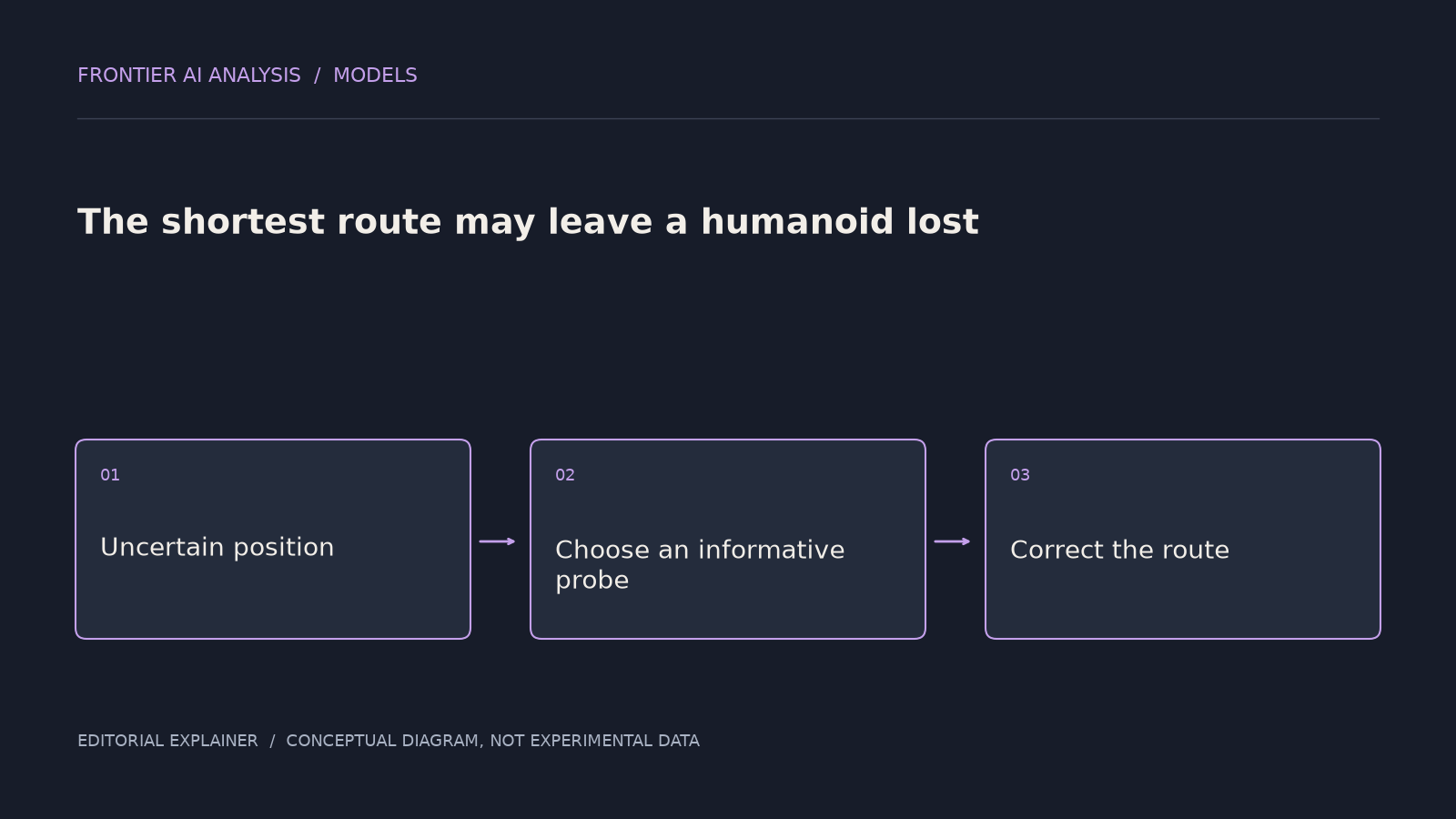
A route through the middle of a corridor can be geometrically efficient and informationally poor. A robot that cannot see may keep walking while becoming less certain about where it is.
TapNav, posted October 7, makes contact with the surroundings part of route planning. The system combines motion estimates, inertial measurements and tactile observations, choosing local probes for their expected information gain. Its global planner seeks routes that keep localisation uncertainty bounded. The researchers report simulation and Unitree G1 experiments in office-scale layouts without vision.
The interesting move is to give an action two kinds of value. A step may bring the robot closer to the destination. A touch may make the robot more certain about the position from which it will take its next step.
Distance is not the only route cost
Consider a hypothetical choice between open space and a route beside a known wall. The first may be shorter. The second may offer opportunities to correct accumulated position error. Once uncertainty enters the calculation, the longer path can become the better route.
This is more subtle than fitting a humanoid with touch sensors and hoping they help. A passive sensor reports what happens to contact it. An active policy chooses a movement partly because the resulting observation will discriminate between possible states of the world.
Even missing an expected surface can carry information. If the robot reaches where it believes a wall should be and detects no contact, its position estimate may need revision. That inference is only useful if the system can distinguish a genuine absence from a failed sensor or an unsuccessful reach.
Exploration has a physical price
A useful information-gathering action is not automatically an acceptable one. A probe takes time, changes the robot’s balance and assumes something about the surface being touched. In a real building, a partition can move; a door can swing; a surface can be unsuitable for contact. These are deployment questions, not conditions established by the office experiments.
The research therefore suggests a broader evaluation than arrival rate. Measure how much uncertainty each probe removes, how much time it costs and what happens when the expected contact is absent. A policy that reaches the destination through frequent, harmless checks may be preferable to one that usually takes a direct route but occasionally loses its place.
There is a design implication for buildings too. If future robots use known contact features to navigate through degraded visibility, environmental structure becomes part of the sensing system. Handrails, edges and stable surfaces might serve as reference points as well as obstacles.
That possibility does not turn TapNav into a validated emergency-response robot. It changes the planning question. Before asking how quickly a machine can cross a room, it may be worth asking where, along the way, it can find out that it is wrong.
References
Questions, news tips or corrections? Contact [email protected].