A robot making parts for its own assembly is an irresistible image. The more consequential detail is how quickly its builders changed what it could do.
In its October 13 API beta announcement, Physical Intelligence describes Almond’s Axol robot learning to deburr spacers used in its assembly after four days of iteration. That is a specific manufacturing task, not a self-replicating factory. The beta offers data upload, managed fine-tuning and hosted inference. The company describes a loop in which failures guide the next collection round; it also acknowledges networking challenges for cloud-hosted operation.
An API changes the boundary of the robotics business. A small team can potentially buy access to model capability that it could not afford to create. Yet the service cannot automatically know which failed attempt in that team’s workshop deserves another hour of demonstrations.
A failure is not yet a lesson
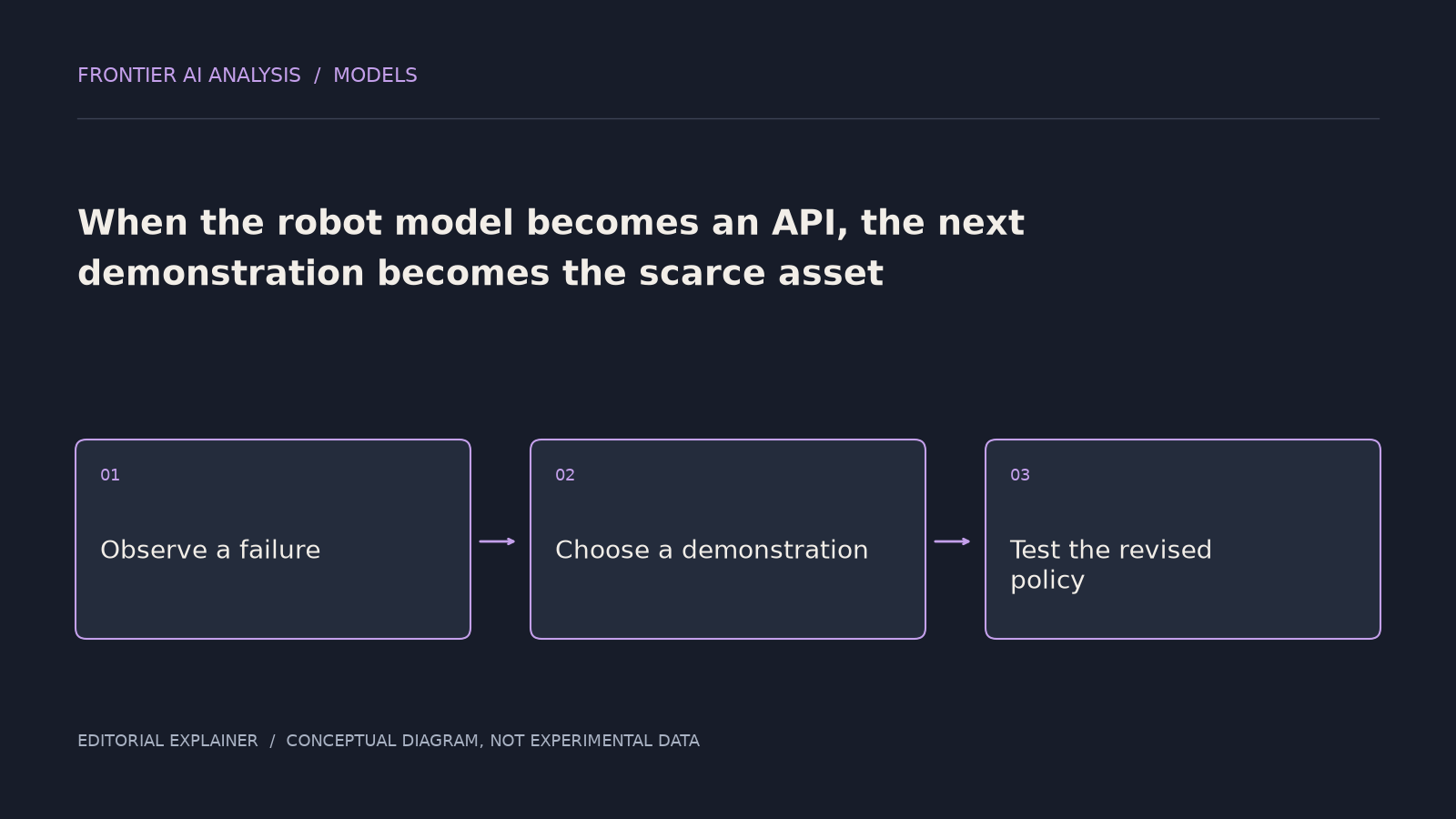
Consider a hypothetical robot that drops a spacer. The useful next demonstration depends on why it dropped it. A slippery grip calls for one intervention; an unseen change in orientation calls for another. A delayed observation might not call for more training data at all.
Collecting another hundred clean successes could be almost irrelevant to any of those problems. The valuable asset is a diagnosis connecting an observed failure to a teachable behaviour, with enough context to reproduce it. Operators who build that discipline could accumulate an advantage even while using the same underlying service as competitors.
This is a different kind of proprietary data from a warehouse of recordings. It includes the reason a demonstration was requested, the conditions under which the old policy failed and the test that showed whether the new one improved. Those links turn footage into an experiment.
The unit of progress is a tested revision
There is a second consequence to buying policy updates through a service. A model improvement has to be attached to a particular robot configuration, task and acceptance test. A workshop cannot simply assume that a newer policy preserves yesterday’s successful handling of every part.
A sensible deployment record would therefore bind together the model version, camera setup, gripper configuration and a small suite of repeatable physical trials. This is an operational implication of iterative model delivery, not a feature the announcement establishes. Without such a record, teams may have difficulty distinguishing a model regression from a change in the workcell.
The beta also makes a commercial question sharper. Who owns the knowledge about which failures matter: the foundation-model supplier, the robot maker or the operator who watches the machine miss a shift target? The answer will depend on contracts and on where the learning loop actually lives.
The API can lower the cost of trying again. It cannot make every retry informative. A team that knows which single demonstration to collect next may gain more than one that can afford thousands of undirected examples.
References
Questions, news tips or corrections? Contact [email protected].