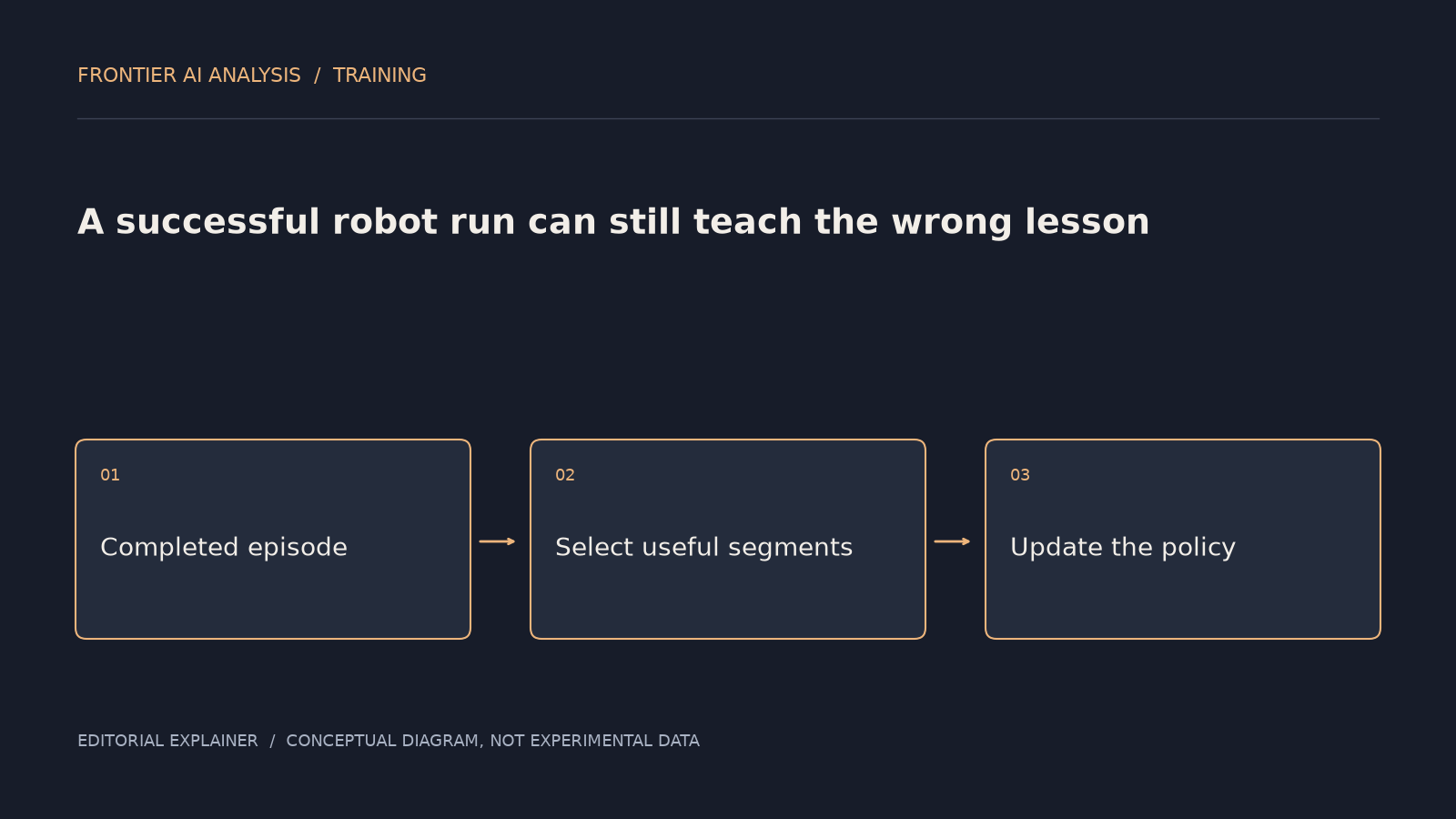
Shrinking a robot policy changes more than the number of weights stored on the machine. When it also takes fewer steps to generate an action, it travels through a different sequence of internal states.
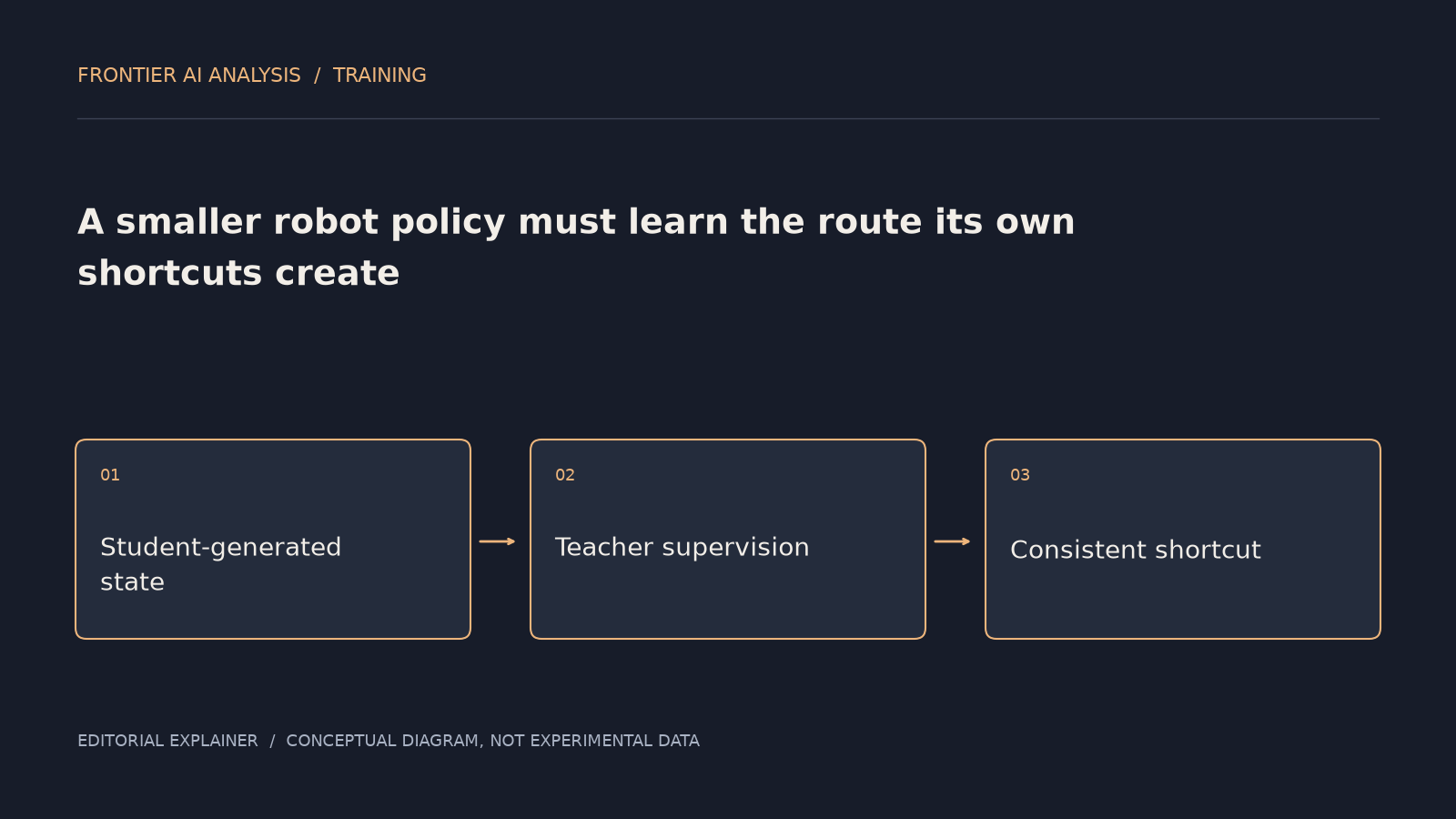
FastOPD, posted October 2, uses teacher supervision at a sampled state reached by the student’s own flow-map jump. A self-consistency objective connects local supervision to larger shortcut transitions. On LIBERO, the authors report retaining 84 percent of the teacher’s performance with two inference steps and a 78.1 percent reduction in inference latency. They also describe a real-robot experiment with a compact student.
Here, “on-policy” refers to the student’s action-generation trajectory. It should not be read as a claim that every training example comes from a robot physically exploring a room.
The teacher may never visit the student’s mistake
A useful way to understand the problem is to imagine teaching someone a route by showing only the correct turns. If the learner takes a shortcut and arrives at a different intersection, the original demonstration may not say how to proceed from there.
In a flow-based action generator, the analogous locations are intermediate numerical states on the way from noise to an action sample. A smaller, faster student can produce states different from those encountered along the teacher’s more elaborate trajectory. Supervising the student where it actually lands addresses that mismatch directly.
The consistency objective adds another requirement: a long jump should agree with composing shorter transitions. That makes the shortcut accountable to the dynamics it is meant to approximate, instead of merely rewarding a plausible-looking endpoint.
Retained performance has a distribution
For a robot buyer, “84 percent retained” invites a second question: which part was lost? Losing a small amount across every task differs from losing one essential task almost entirely. A mean retention figure does not distinguish those cases.
The deployment comparison should therefore preserve the task breakdown and pair the teacher and student on matched conditions. It should also measure physical completion time. Lower action-generation latency may help, but a cheaper policy that requires more retries could consume some of the saved time.
There is a training-economics question as well. A student is cheap to run only after somebody has paid to make it. Reducing repeated teacher evaluations can make distillation practical for more tasks, but that cost needs to be amortised over the expected deployment volume.
FastOPD’s useful contribution is to treat compression as a change in the generating process, with a corresponding training problem. A compact policy is not simply a large policy with pieces removed. It needs supervision for the shortcuts it will actually take.
References
Questions, news tips or corrections? Contact [email protected].